NOTE CORRECTED ADDRESS!
The Tulare Astronomical Association will hold its annual business meeting on Tuesday, June 5 at 6 p.m. at 3124 W. Hillsdale Dr. in Visalia. All interested parties are invited to attend.
Map to the meeting.
Thursday, May 31, 2007


Monday, May 28, 2007
Mars Joins Planetary Parade
Mars Joins Planetary Parade
by Dave Adalian
In my last column, I took you on a tour of the naked-eye planets, starting at sunset with elusive Mercury and ending in the early morning hours with blue Neptune. This time, another member of the solar system entourage joins the show while two others put in their best appearances of the year.by Dave Adalian
Tiny Mercury, a rocky planet just 3,000 miles wide, sits closest to the Sun, making it a bit of a challenge to view. But on Saturday, Mercury will be as far as it ever gets from the Sun as seen from Earth, a condition known as greatest elongation.
While Mercury, swift-footed messenger to the gods, will be visible for another couple of weeks, now, before it falls back into the fiery skirts of Sol, is the best time to see it. Look a bit north of dead west about an hour after the Sun retires to find it.
Don’t confuse Mercury with its brighter sister, Venus, also prominent in the west after sundown. This brightest of planets reaches greatest elongation one week after Mercury, but being farther from the Sun rides higher in the sky. Venus is a bright white, while Mercury, seen through more of Earth’s atmosphere, appears pink. Beside Venus are the twin suns of Gemini, Pollux and Castor.
Imagine a line through Mercury and Venus and follow it up the sky about the same distance as the current separation of Mercury and Venus. There, you’ll find Saturn, still sitting like a cosmic ball of yarn before the paws of Leo the Lion.
Saturn and Venus are headed for a close conjunction toward the end of June, so watch them night-to-night as grow ever closer together. Both will be gone from the sky by late July.
While the western trio is riding high, the King of Worlds, Jupiter, is rising in the southeast. By 11 o’clock it is well placed for viewing.
By 3 a.m., Neptune is high enough to be seen--if the sky is dark enough--but a chart is necessary to find it. (See link to a finder chart below.)
About an hour and a half later, just before dawn’s probing fingers creep above the horizon, look east to find Mars’ shining ruddily.
The Red Planet bears watching over the next year as it sweeps toward a close pass of Earth on Christmas Eve then fades back into the distant reaches of the Solar System, not to return again until mid-2009.
++++++++++++++++++++
This column appeared originally in the Visalia (Calif.) Times-Delta and Tulare (Calif.) Advance-Register on May 31, 2007.
Wednesday, May 23, 2007
Finding Neptune (and Uranus, too!)
Here's a link to a set of charts to help planet-hunters find the dimmest of naked-eye planets, Neptune. The charts are also good for finding Uranus, but you'll need at least a pair of binoculars to see it.
http://www.rasnz.org.nz/SolarSys/UranNept.htm
Thanks to the Royal Astronomical Society of New Zealand for the charts.
http://www.rasnz.org.nz/SolarSys/UranNept.htm
Thanks to the Royal Astronomical Society of New Zealand for the charts.
Sunday, May 20, 2007
Conjunction Images
Here's a shot of Venus and the new moon I took from my backyard in Visalia, Calif. around 8:45 p.m. PDT on May 19, 2007.
http://farm1.static.flickr.com/195/505508659_ef30c03152_b.jpg
Here's the best of the snaps I got of the Mercury-Moon conjunction two nights earlier from a local park about 8 o'clock:
http://farm1.static.flickr.com/224/505499552_1e4120f52c_b.jpg
http://farm1.static.flickr.com/195/505508659_ef30c03152_b.jpg
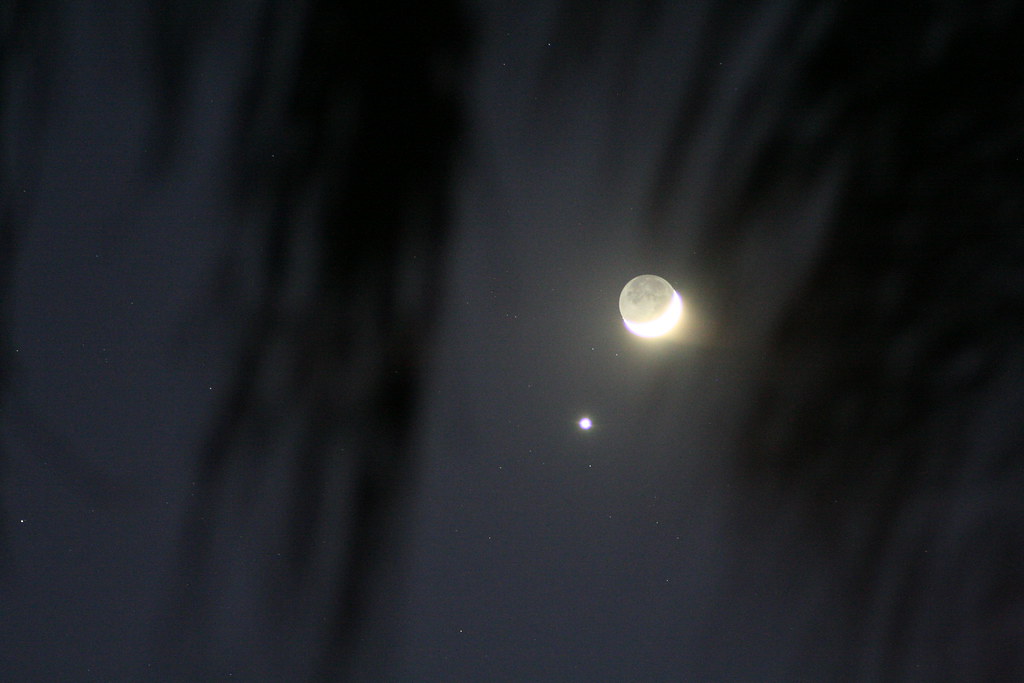
Here's the best of the snaps I got of the Mercury-Moon conjunction two nights earlier from a local park about 8 o'clock:
http://farm1.static.flickr.com/224/505499552_1e4120f52c_b.jpg

Wednesday, May 09, 2007
Planetary Tour Starts Tonight
Planetary Tour Starts Tonight (May 3, 2007)
by Dave Adalian
by Dave Adalian
You may be one of the many people who found themselves with a sudden interest in the stars and planets after the announcement last month of the discovery of a possibly earthlike planet just 20.4 years away.
If the first earthlike planet we’ve found is this close, imagine how many others there must be in a galaxy bigger than 100,000 light years across. Suddenly, the possibility we’ve got neighbors who could be peering back at us with their own telescopes from their own backyards becomes tantalizingly real.
The star the newly discovered planet orbits, Gliese 581, is a dim red dwarf in the constellation Libra, and it doesn’t do much for the imagination, especially if you’re a newly minted planet-gazer looking for something to hang your dreams of space upon.
But, I’ve got good news for you would-be space cases: there is a bevy of much closer planets you can see with your own eyes starting tonight.
If you look west tonight just after sunset, you’ll find the brightest of the naked-eye planets, brilliant Venus, shining like a jewel. This sister planet to Earth will be spending the entire summer as the evening star.
To find the largest of the local planets, you’ll have to stay up tonight until the Moon rises around 11 o’clock. When it makes its way skyward, it will sit just to the right and below Jupiter.
Though you’ll need a telescope if you want to see it, the recently demoted dwarf planet Pluto is to Jupiter’s left. The bright red star to the right and above the Moon is Antares.
When Jupiter and the Moon are just entering the sky, Saturn will be in the opposite direction, sitting well above the horizon to the west in the constellation Leo.
The dimmest of the naked-eye planets, sea-blue Neptune, is rising in the early morning these days, around 3 o’clock. It takes a dark sky to see Neptune, but you can get a very good idea of its general location when the Moon rises near it on the morning of May 10.
On the evening of May 17, the Moon will be back in the west just after sunset, this time with elusive Mercury just below it. The Moon will be the barest slice, just a few hours past new, and may itself be difficult to find.
Finish your springtime planetary tour on May 19 when Venus and the Moon meet in an incredibly close pairing that’s sure to dazzle.
++++++++++++++++++++
This column appeared originally in the Visalia (Calif.) Times-Delta and Tulare (Calif.) Advance-Register on May 3, 2007.
Thursday, March 29, 2007
Venus Visits Star Sisters
Venus visits star sisters
by Dave Adalian
If you go out tonight around 8:30 p.m. and look west you’ll find white Venus shining brilliantly back at you from above the horizon.
Venus will be about 20 degrees high or four times the width of your fist held at arm’s length with knuckles raised and thumb tucked. Not quite that same distance above Venus you’ll discover a cluster of blue-white stars in the shape of a tiny dipper. They are the Pleiades, or Seven Sisters, and they’re on course for a close pass with Venus that will be a stargazer’s delight.
Of course their apparent proximity will be just an illusion. Venus is never farther than 160 million miles from Earth, while the Seven Sisters are some 400 light years away.
And there are a lot more than just seven sisters. Most folks see just six of the Pleiades with their naked eyes. Viewing with binoculars drives the number much higher, and a telescope reveals 100 or so suns blazing away in a cluster that fills a spherical area 14 light years across.
The much smaller but brighter Venus is a dainty 8,000 miles wide, just a deep breath thinner than its twin Earth.
While these celestial ladies look to be a fair distance apart at the moment, over the next couple of weeks they’ll pull together until they’re a scant 2.5 degrees separate, close enough an extended hand could hide them.
It just so happens Venus will seem to stand almost perfectly still with respect to the Sun over the next few weeks, so most of the effect we’ll be witnessing is the stars shifting as the days of spring pass and Earth races through its orbit at some 67,000 miles an hour.
The change will be subtle at first. It takes until Tuesday for the Pleiades to close to within 10 degrees of Venus, but then the pace picks up and the distance will be 5 degrees by Saturday, April 7, and only 4 degrees the next night.
The gap shrinks about half a degree a night until Venus and the Seven Sisters reach their closest on Wednesday, April 11. The two will still be a mere 2.75 degrees apart the next night and only 3 degrees distant the night after that.
Venus will still be just 10 degrees above the Seven Sisters on Thursday, April 19, when a thin slice of crescent moon settles between them.
++++++++++++++++++++
This column originally appeared in the Visalia (Calif.) Times-Delta and Tulare (Calif.) Advance-Register on March 29, 2007.
Thursday, February 15, 2007
Winter Skies Are Tricky
Winter Skies Are Tricky
by Dave Adalian
Icy February nights aren’t well suited to stargazing, but this winter the Solar System is putting on an early evening show that will have planet hunters back safe and warm at a reasonable hour.
But, when those would-be planet seekers trudge home they may feel frustrated as the skies are presenting a trio of difficult challenges this month.
In early evening since the year began the most brilliant of the planets, Earth’s twin Venus, has shone like a searchlight in the western sky in the hours after sunset. While there’s nothing difficult about finding this fiery gem after dark, those who like a real challenge can search for cloud-covered Venus winking in the deep blue while the Sun is still up.
To find any planet when the Sun is still above the horizon, it’s important to know exactly where to look. The easiest way to know where Venus will be is locating it just after sunset the night before a daytime search.
If that’s too easy, the try looking for Venus about 10 degrees to the left of the Sun--that’s about two widths of a fist held at arm’s length--and about 25 degrees above it--about five fists’ worth. Stand in a shadow to cut down on glare, and do not look directly at the Sun for any reason.
Despite any frustration this may cause, do not attempt to aid a daytime search with binoculars or a telescope because even a brief accidental view of the Sun can cause permanent eye damage or even blindness.
The next challenge has to be completed before Mercury moves back into the Sun’s glare this weekend. The innermost planet has just passed greatest elongation, when it appears farthest from the Sun, and it is visible just above the horizon right after sunset. Because Mercury never rises far from the Sun, it can be difficult to find and many longtime amateur astronomers have never viewed it, making it a feather in the planet hunter’s cap.
The final February planetary challenge is on the other side of the sky, where Saturn is now rising as the Sun sets in the west. To find it among the stars of Leo, look a bright light that doesn’t shimmer like the rest of the stars. The full moon will remove any doubt of Saturn’s identity on March 1 when it rides beside it through the sky all night long.
++++++++++++++++++++
This column appeared originally in the Visalia (Calif.) Times-Delta on Feb. 15, 2007.
by Dave Adalian
Icy February nights aren’t well suited to stargazing, but this winter the Solar System is putting on an early evening show that will have planet hunters back safe and warm at a reasonable hour.
But, when those would-be planet seekers trudge home they may feel frustrated as the skies are presenting a trio of difficult challenges this month.
In early evening since the year began the most brilliant of the planets, Earth’s twin Venus, has shone like a searchlight in the western sky in the hours after sunset. While there’s nothing difficult about finding this fiery gem after dark, those who like a real challenge can search for cloud-covered Venus winking in the deep blue while the Sun is still up.
To find any planet when the Sun is still above the horizon, it’s important to know exactly where to look. The easiest way to know where Venus will be is locating it just after sunset the night before a daytime search.
If that’s too easy, the try looking for Venus about 10 degrees to the left of the Sun--that’s about two widths of a fist held at arm’s length--and about 25 degrees above it--about five fists’ worth. Stand in a shadow to cut down on glare, and do not look directly at the Sun for any reason.
Despite any frustration this may cause, do not attempt to aid a daytime search with binoculars or a telescope because even a brief accidental view of the Sun can cause permanent eye damage or even blindness.
The next challenge has to be completed before Mercury moves back into the Sun’s glare this weekend. The innermost planet has just passed greatest elongation, when it appears farthest from the Sun, and it is visible just above the horizon right after sunset. Because Mercury never rises far from the Sun, it can be difficult to find and many longtime amateur astronomers have never viewed it, making it a feather in the planet hunter’s cap.
The final February planetary challenge is on the other side of the sky, where Saturn is now rising as the Sun sets in the west. To find it among the stars of Leo, look a bright light that doesn’t shimmer like the rest of the stars. The full moon will remove any doubt of Saturn’s identity on March 1 when it rides beside it through the sky all night long.
++++++++++++++++++++
This column appeared originally in the Visalia (Calif.) Times-Delta on Feb. 15, 2007.
Monday, January 15, 2007
A Ring Fire in the Sky
A Ring Fire in the Sky
by Dave Adalian
By far the brightest stars of the year are to be found in the skies on winter nights, glinting like shards of ice in the frozen heavens.
The brightest of the bright stand together early in the southeast, describing an enormous ring stretching from a hand’s breadth above the horizon to almost the top of the sky just an hour or two after nightfall.
Lowest and brightest among these jewels of the young year is Sirius, the Dog Star, which shines, glinting and shimmering with spikes of every color as it dances in the turbulent air, directly to the southeast. Brightest of all stars we can see from Earth at magnitude -1.5, Sirius marks Canis Major, faithful hound of Orion the Hunter.
Orion is home to Rigel, another blue-white gem that is the Hunter’s foot just above and to the right of Sirius. A dimmer star than dazzling Sirius, magnitude 0 Rigel--seventh brightest in the sky--only fails to outshine Sirius because it is more than 100 times farther away.
To the left of Rigel and inside the ring of winter gems is Betelgeuse, a magnitude 0.5 red star that ranks ninth among its peers.
Continuing on around the ring of fire find angry Aldebaran, the orange-red eye of Taurus the Bull. This 13th brightest star shines at just under magnitude 1 and is directly above Orion’s head as the Bull charges down upon the Hunter.
The highest point of the fiery ring is Capella, a yellow diamond of magnitude 0, sixth brightest of the stars in the sky. Capella is the she-goat and it rides across the sky carried in the arms of Auriga the Charioteer, a constellation that is itself a ring of stars.
Dropping back toward the horizon, look for the bright twins of Gemini, Castor and Pollux, directly below and slightly to the left of Capella. Orangish Pollux is merely the 16th brightest of the night’s stars, just dimmer than magnitude 1, but perhaps it seems to the eye to glow with more luster when aided by Castor, his nearby magnitude 1.5 brother.
Lower than the twins and seated between them and brightest Sirius is Procyon, another shining yellow-white gem. At a bit dimmer than magnitude 0, Procyon is the eighth brightest of the stars and the brightest of the tiny constellation Canis Minor, the lesser of Orion’s hunting companions.
++++++++++++++++++++
This column originally appeared in the Visalia (Calif.) Times-Delta in January of 2007.
by Dave Adalian
By far the brightest stars of the year are to be found in the skies on winter nights, glinting like shards of ice in the frozen heavens.
The brightest of the bright stand together early in the southeast, describing an enormous ring stretching from a hand’s breadth above the horizon to almost the top of the sky just an hour or two after nightfall.
Lowest and brightest among these jewels of the young year is Sirius, the Dog Star, which shines, glinting and shimmering with spikes of every color as it dances in the turbulent air, directly to the southeast. Brightest of all stars we can see from Earth at magnitude -1.5, Sirius marks Canis Major, faithful hound of Orion the Hunter.
Orion is home to Rigel, another blue-white gem that is the Hunter’s foot just above and to the right of Sirius. A dimmer star than dazzling Sirius, magnitude 0 Rigel--seventh brightest in the sky--only fails to outshine Sirius because it is more than 100 times farther away.
To the left of Rigel and inside the ring of winter gems is Betelgeuse, a magnitude 0.5 red star that ranks ninth among its peers.
Continuing on around the ring of fire find angry Aldebaran, the orange-red eye of Taurus the Bull. This 13th brightest star shines at just under magnitude 1 and is directly above Orion’s head as the Bull charges down upon the Hunter.
The highest point of the fiery ring is Capella, a yellow diamond of magnitude 0, sixth brightest of the stars in the sky. Capella is the she-goat and it rides across the sky carried in the arms of Auriga the Charioteer, a constellation that is itself a ring of stars.
Dropping back toward the horizon, look for the bright twins of Gemini, Castor and Pollux, directly below and slightly to the left of Capella. Orangish Pollux is merely the 16th brightest of the night’s stars, just dimmer than magnitude 1, but perhaps it seems to the eye to glow with more luster when aided by Castor, his nearby magnitude 1.5 brother.
Lower than the twins and seated between them and brightest Sirius is Procyon, another shining yellow-white gem. At a bit dimmer than magnitude 0, Procyon is the eighth brightest of the stars and the brightest of the tiny constellation Canis Minor, the lesser of Orion’s hunting companions.
++++++++++++++++++++
This column originally appeared in the Visalia (Calif.) Times-Delta in January of 2007.
Friday, December 15, 2006
Give the Gift of the Stars
Give the Gift of the Stars
by Dave Adalian
If there’s someone on your holiday list who’s got stars in their eyes, then the gift of astronomy might be a perfect solution, and it can be done without breaking the bank.
The best way to start someone on the hobby of amateur astronomy is to get them out under the heavens with nothing but their naked eyes.
To learn the bright stars and the constellations they’ll need a set of star maps, which can be found in lots of places, either on their own in sky atlases or as part of a publication.
Atlases tend to be pricey and are definitely geared toward the experienced observer using a telescope, so for the beginner a better gift is a book or perhaps a magazine subscription.
Terence Dickinson’s Nightwatch: A Practical Guide to Viewing the Universe is an excellent title for would-be astronomers young and old. It includes a good set of simple maps as well as advice on getting started in the hobby and chapters on various aspects of the night sky such as planets, star clusters and galaxies.
For very young stargazers, Find the Constellations by H.A. Rey, author of the Curious George books, might be a better fit.
For someone who’s already read a bit about the hobby, a magazine subscription is a better idea. Both Astronomy and Sky and Telescope feature monthly calendars with sky charts and have the added bonus of articles on stargazing for all experience levels.
Buying a telescope is usually a personal experience for the amateur observer and isn’t something that should be done without lots of research, so I don’t recommend it as a gift idea. But, a good sturdy pair of binoculars can make an excellent first set of optics for beginning stargazers.
Binoculars are rated by a pair of numbers separated by an X. The first number is the magnification, and the second is the size of the objective lenses. To be useful for astronomy, binoculars should be at least 7x35s--they magnify objects by seven times and have lenses 35mm wide. Better would be a pair of 10x50s, which can usually be had at local department and sporting goods stores for $20 to $40.
And if the stars in your would-be observer’s eyes fade, binoculars have dozens of other terrestrial uses, from bird watching to viewing sporting events and won’t go to waste.
If none of this appeals then remember that it’s cold on those long winter watches after dark. The gift of a warm hat or a thick sweater also suits those who spend their nights under the stars.
++++++++++++++++++++
This column originally appeared in the Visalia (Calif.) Times-Delta in December of 2006.
by Dave Adalian
If there’s someone on your holiday list who’s got stars in their eyes, then the gift of astronomy might be a perfect solution, and it can be done without breaking the bank.
The best way to start someone on the hobby of amateur astronomy is to get them out under the heavens with nothing but their naked eyes.
To learn the bright stars and the constellations they’ll need a set of star maps, which can be found in lots of places, either on their own in sky atlases or as part of a publication.
Atlases tend to be pricey and are definitely geared toward the experienced observer using a telescope, so for the beginner a better gift is a book or perhaps a magazine subscription.
Terence Dickinson’s Nightwatch: A Practical Guide to Viewing the Universe is an excellent title for would-be astronomers young and old. It includes a good set of simple maps as well as advice on getting started in the hobby and chapters on various aspects of the night sky such as planets, star clusters and galaxies.
For very young stargazers, Find the Constellations by H.A. Rey, author of the Curious George books, might be a better fit.
For someone who’s already read a bit about the hobby, a magazine subscription is a better idea. Both Astronomy and Sky and Telescope feature monthly calendars with sky charts and have the added bonus of articles on stargazing for all experience levels.
Buying a telescope is usually a personal experience for the amateur observer and isn’t something that should be done without lots of research, so I don’t recommend it as a gift idea. But, a good sturdy pair of binoculars can make an excellent first set of optics for beginning stargazers.
Binoculars are rated by a pair of numbers separated by an X. The first number is the magnification, and the second is the size of the objective lenses. To be useful for astronomy, binoculars should be at least 7x35s--they magnify objects by seven times and have lenses 35mm wide. Better would be a pair of 10x50s, which can usually be had at local department and sporting goods stores for $20 to $40.
And if the stars in your would-be observer’s eyes fade, binoculars have dozens of other terrestrial uses, from bird watching to viewing sporting events and won’t go to waste.
If none of this appeals then remember that it’s cold on those long winter watches after dark. The gift of a warm hat or a thick sweater also suits those who spend their nights under the stars.
++++++++++++++++++++
This column originally appeared in the Visalia (Calif.) Times-Delta in December of 2006.
Friday, November 10, 2006
Clouded Out!
Looks like we're in for a weekend of cloudy and possibly rainy weather, which means no star hunting tonight (Friday, Nov. 10). Enjoy the wet stuff folks, and maybe we'll get back to star gazing next month.
-- Dave
-- Dave
Meteor Magic on Demand
Meteor Magic on Demand
by Dave Adalian
by Dave Adalian
Almost everyone has been dazzled by the sight of a meteor burning its way across the dark heavens on a starry night.
There’s something magical about those little bits of dust no bigger than a grain of rice superheating the atmosphere as they come rushing at speeds dozens of times faster than sound.
The only trouble is you can never tell when you’ll see a shooting star.
Some may say not knowing when a meteor will fall from the sky is part of their particular magic. I happen to disagree.
Even when you know there is likely to be a meteor shower, as there should be Saturday night, Nov. 18, when the Leonids reach their annual peak, the magic is still powerful.
Those who wish to experience this bit of scheduled magic will find the shower’s peak timed slightly too early for our side of the globe, but there should still be a good show.
The Leonids, which take their name from the constellation Leo the Lion where they appear to originate, should reach highest concentration at about 8:45 p.m.
While it will already be plenty dark by then, Leo will not have risen above the eastern horizon and won’t until around 2 a.m., which is the best time to see the Leonids.
Even so, at the time of the peak observers here may get a special treat, an abundance of “Earth grazers”, meteors that shoot from one side of the sky to the other. The number of meteors to be seen is impossible to say, though a more realistic count is 10 to 25 an hour during the course of the entire night.
That number, of course, describes what might be seen under ideal conditions of a dark sky with Leo well above the horizon at the moment of the shower’s peak.
While there won’t be a high flying lion at peak, we can maximize our meteor potential by seeking darker skies than those in our backyard. Falling star seekers should head to the hills or at least well outside the city limits as urban viewers will miss three quarters of the show.
Wherever you go to view the Leonids, bring along a chair that will let you comfortably scan the sky about 60 degrees above the horizon, and point your toes toward the darkest part of the night.
Remember to dress warmly for an extended stay in the cold, and don’t forget the warm drinks and snacks.
++++++++++++++++++++
Join the star hunters of the Tulare Astronomical Association this Friday night, Nov. 10, 7-9 p.m. for a look at the stars of late autumn at the Arthur L. Purcell Observatory, 9242 Ave. 182, 2.1 miles west of Highway 99 and south of Tulare. Information and directions: http://starry-starry-nights.blogspot.com/.
++++++++++++++++++++
This column originally appeared in the Visalia (Calif.) Times-Delta and Tulare (Calif.) Advance-Register on Nov. 9, 2006.
There’s something magical about those little bits of dust no bigger than a grain of rice superheating the atmosphere as they come rushing at speeds dozens of times faster than sound.
The only trouble is you can never tell when you’ll see a shooting star.
Some may say not knowing when a meteor will fall from the sky is part of their particular magic. I happen to disagree.
Even when you know there is likely to be a meteor shower, as there should be Saturday night, Nov. 18, when the Leonids reach their annual peak, the magic is still powerful.
Those who wish to experience this bit of scheduled magic will find the shower’s peak timed slightly too early for our side of the globe, but there should still be a good show.
The Leonids, which take their name from the constellation Leo the Lion where they appear to originate, should reach highest concentration at about 8:45 p.m.
While it will already be plenty dark by then, Leo will not have risen above the eastern horizon and won’t until around 2 a.m., which is the best time to see the Leonids.
Even so, at the time of the peak observers here may get a special treat, an abundance of “Earth grazers”, meteors that shoot from one side of the sky to the other. The number of meteors to be seen is impossible to say, though a more realistic count is 10 to 25 an hour during the course of the entire night.
That number, of course, describes what might be seen under ideal conditions of a dark sky with Leo well above the horizon at the moment of the shower’s peak.
While there won’t be a high flying lion at peak, we can maximize our meteor potential by seeking darker skies than those in our backyard. Falling star seekers should head to the hills or at least well outside the city limits as urban viewers will miss three quarters of the show.
Wherever you go to view the Leonids, bring along a chair that will let you comfortably scan the sky about 60 degrees above the horizon, and point your toes toward the darkest part of the night.
Remember to dress warmly for an extended stay in the cold, and don’t forget the warm drinks and snacks.
++++++++++++++++++++
Join the star hunters of the Tulare Astronomical Association this Friday night, Nov. 10, 7-9 p.m. for a look at the stars of late autumn at the Arthur L. Purcell Observatory, 9242 Ave. 182, 2.1 miles west of Highway 99 and south of Tulare. Information and directions: http://starry-starry-nights.blogspot.com/.
++++++++++++++++++++
This column originally appeared in the Visalia (Calif.) Times-Delta and Tulare (Calif.) Advance-Register on Nov. 9, 2006.
Wednesday, October 25, 2006
The Lion, the Moon and Saturn
The Lion, the Moon and Saturn
by Dave Adalian
by Dave Adalian
Starting before dawn on Monday morning, the Moon will enter the belly of the beast.
In the early morning, around an hour or so before sunrise, the slender crescent of a waning moon will lie due east, sitting like a cosmic ball of yarn between the paws of Leo the Lion.
But, it won’t be alone. Just below and the to the right of the Moon will be the bright, yellow ringed planet Saturn, making it a cinch to find this second largest of the eight planets.
While it will seem the Moon and Saturn are so close they could reach out and touch one another, in reality the Moon is just 220,000 or so miles from Earth, while Saturn is more than 900 million miles away at present. And, while Saturn, a simple pinprick in the sky, seems much smaller than our 2,000-mile-wide Moon, it is actually 75,000 miles across.
In fact, Saturn’s rings are the largest structure in the Solar System besides the Sun itself. Measured side to side, Saturn’s ring system is an impressive 155,000 miles wide.
On Tuesday morning, a still thinner Moon will head deeper into Leo, sitting just below the lion’s brightest star, Regulus. The word Regulus is Latin for “the prince,” and is sometimes referred to as Cor Leonis, or the heart of the lion.
Regulus is a young, fast spinning star, making a complete revolution about every 16 hours, a spin so quick it makes the star bulge in the middle. And, while Regulus is a very bright first-magnitude star, it is actually 77.5 light years away.
By Wednesday morning, the Moon will have moved on again, its crescent growing smaller still as it leaves Leo and passes just to the right of the brightest star in Leo’s tail, Denebola, a name which means “tail of the lion” in the original Arabic.
While second-magnitude Denebola is not nearly as bright as Regulus, it is actually larger at 1.6 million miles wide compared to Regulus’ 1.4 million mile girth. It’s also closer, less than half as far away at 36 light years.
If Denebola is closer and bigger than Regulus, why does Regulus shine more brightly? Simply because it is hotter, its higher temperature making it shine 350 times brighter than our Sun. Cooler Denebola is a mere 12 times brighter than 865,000-mile-wide Sol.
++++++++++++++++++++
Join the Tulare Astronomical Association for a look at the stars of autumn Friday, 7:30 to 9:30 p.m., at the Arthur L. Purcell Observatory, 9242 Ave. 182, south of Tulare and 2.1 miles west of Highway 99. Information and directions: http://starry-starry-nights.blogspot.com/.
++++++++++++++++++++
This column originally appeared in the Visalia (Calif.) Times-Delta and Tulare (Calif.) Advance-Register on Oct. 12, 2006.
Don’t Mourn for Pluto
Don’t Mourn for Pluto
by Dave Adalian
by Dave Adalian
After 76 years as the Solar System’s ninth planet, Pluto suddenly finds himself all alone out in the cold.
Of course, he’s probably used to that by now.
At a meeting of the International Astronomical Union last month, Pluto was stripped of its status and reclassified as a “dwarf.”
The poor little guy. But, does he deserve it?
Truth be told, Pluto is a whole lot different than his Sun-hugging cousins.
First off, he’s tiny, about half the diameter of Mercury, smallest of the rocky inner planets, smaller than many of the other planets’ moons, including Earth’s. His size really isn’t all that odd, except Pluto lives in the land of the gas giants, the smallest of which, Neptune, could hold 60 Earths if it were hollow.
Making Pluto even odder, his axis is inclined so much his north pole points at the Sun. But, he’s not alone here. Uranus, too is tilted on its side.
Also, the largest of Pluto’s three moons, Charon, is almost half as big as he is, making them a double system in the minds of some astronomers. And again, he’s not alone in this. Earth and the Moon are somewhat similar in size and considered a double planet in some circles.
So, what’s the fuss?
Well, the IAU’s new definition of a planet says planets have orbit the Sun, have to be round, can’t orbit another planet and have to clear their orbit of other objects. It’s that last item that’s gotten Pluto in hot water.
Pluto takes a unique path around the Sun. Not only is his orbit tilted, taking it up and down like a horse on a merry-go-round, that orbit is also highly eccentric, sometimes taking the small body inside the orbit of Neptune.
Pluto doesn’t move like the other planets do because it is one of the largest objects in the Kuiper Belt, and since there are thousands of other Kuiper Belt objects sharing Pluto’s orbit, he just doesn’t fit the IAU’s new definition. So, out he goes.
In general, astronomers aren’t an excitable bunch, but the decision last month has professional stargazers around the world crying foul. The vote, held on the last day of the IAU’s meeting, only included the opinion of a handful of the body’s 10,000 or so members, many of whom are calling for another vote on the matter.
So, Pluto might regain his status as a planet the next time the IAU comes together. Either way, Pluto probably doesn’t much care what people on a planet so far away it can’t even be seen from where he sits call him.
++++++++++++++++++++
This column originally appeared in the Visalia (Calif.) Times-Delta and Tulare (Calif.) Advance-Register on Sept. 14, 2006.
Planets Dance in the Predawn Light
Planets Dance in the Predawn Light
by Dave Adalian
Early risers and those who like to stay up until dawn will be treated to a planetary dance if they’ll look to the east before first light all next week.
On Sunday morning just before the Sun rises three planets will hover just above the eastern horizon. Brightest and easiest to find of the trio will be Earth’s twin sister Venus.
This 8,000-mile-wide orb is about the same size as our own planet, but covered with a planet-wide haze that reflects back much of the light that strikes it, making it one of the most dazzling sights in the night sky.
Closer to the horizon and to the left of Venus will be a close pairing of Mercury and Saturn. On Sunday morning, Mercury will sit about a degree above the ringed planet and both will be very close to the horizon. Twenty-four hours later, the pair will have switched positions, with swift-footed 3,000-mile-wide Mercury moving so quickly toward the Sun it will appear about one degree below slower-moving Saturn.
Also joining the dance on Monday morning will be a very slender crescent moon sitting above the planetary trio. The Moon will be even thinner still, as thin as you are ever likely to see it on the last day of its 28-day cycle, on Tuesday morning when it floats near Saturn’s left-hand side.
For a striking example of what a difference distance makes for planetary viewing, remember that our moon is just 850 miles more narrow than faraway Mercury but appears roughly 166 times larger to the naked eye.
For a striking example of what a difference distance makes for planetary viewing, remember that our moon is just 850 miles more narrow than faraway Mercury but appears roughly 166 times larger to the naked eye.
By Wednesday morning, Venus and 75,000-mile-wide Saturn will be all alone in the eastern sky with Mercury lost in the wash of predawn brightening.
Their other dance partners now gone, Venus and Saturn will go it alone over the next several mornings while Venus makes its way closer to Saturn and sunup each day.
On Tuesday, with the Moon close at hand, Saturn and Venus were some 5 degrees apart, by Friday the gap will have narrowed to less than 2 degrees, or about four times the width of the full moon.
The gap will be at its smallest over the weekend when Venus will be less than one degree above Saturn, and the final move of the celestial cotillion will come on Sunday morning when the two change position, with Saturn now less than a degree above Venus.
++++++++++++++++++++
Join the Tulare Astronomical Association for its monthly public star party this Friday, 9-11 p.m., at the Arthur L. Purcell Observatory, 9242 Ave. 184, south of Tulare and 2.1 miles west of Highway 99. Information and direction: http://starry-starry-nights.blogspot.com/.
++++++++++++++++++++
This column originally appeared in the Visalia (Calif.) Times-Delta and Tulare (Calif.) Advance-Register on Aug. 17, 2006.
++++++++++++++++++++
This column originally appeared in the Visalia (Calif.) Times-Delta and Tulare (Calif.) Advance-Register on Aug. 17, 2006.
Saturday, June 24, 2006
A Sky Without Stars
A Sky Without Stars
by Dave Adalian
The greatest bane of astronomers is encroaching light.
When the Moon is full or the neighbor leaves his porch light on all night the splendor of the starry sky is ruined.
Fortunately, in Tulare County (Calif.) we can always retreat to the countryside and the vast open acres of croplands and grasslands.
My favorite place to remove myself from the lights of an increasingly bright Central (San Joaquin) Valley is the lonely cattle country of Yokohl Valley east of Rocky Hill.
Out among rolling hills covered in brown grass baked in the heat the sky is still a jewel encrusted dome, where thousands of lights dazzle on a velvet backdrop. Just minutes from downtown Visalia (Calif.), where the star clouds of the Milky Way are never seen, our home galaxy stretches itself from horizon to horizon so beautifully it pulls the breath from your body.
Just five miles down a winding two-lane road there is isolation almost complete, where seeing more than two cars in a night is heavy traffic. Owls cry in the dark. Coyotes yip and laugh and howl to one another among the silhouettes of ancient oak trees standing sentinel on far away ridge tops. It is so quiet you can hear the clicking screech of bats finding their way through blinding inkiness.
Yokohl Valley is a place that I hold dear, and it has been my secret retreat for a dozen years. Now, I’m sharing it with you.
You’d better get there soon.
I’ve been selfish with my hideaway, but no more. As many people as can come should see the wonder of this hidden foothill valley before it’s gone.
An international corporation has decided to turn my secret Eden into a retirement community. If our leaders lend support to this idea, the splendor of Yokohl Valley will soon be no more.
The land will still be there. The stars will still shine overhead, too, but we’ll never see them in the glow of a thousand shining street lights.
Come out to Yokohl Valley before the Sun sets and let the blazing summer turn into cool, dark night around you. Let the sweet smell of wild grasses baked in the sun fill your senses. Hear nighthawks’ screams echo among the rocks and feel the chill on your skin as the coyotes call to one another across the empty spaces.
See the stars shining over this doomed valley before they’re lost forever.
++++++++++++++++++++
Join the Tulare Astronomical Association for a public star party this Friday, 9:30-11:30 p.m., at the Purcell Observatory, 9242 Ave 198, south of Tulare (Calif.) and 2.1 miles west of Hwy 99. Information: http://starry-starry-nights.blogspot.com/.
++++++++++++++++++++
This column originally appeared in the Visalia (Calif.) Times-Delta and Tulare (Calif.) Advance-Register on Thurs., July 13, 2006.
Tuesday, June 13, 2006
Solstice Marks Summer's Start
Solstice Marks Summer's Start
by Dave Adalian
Soaring temperatures may make it seem like summer has already arrived, but even so the astronomical start of the season is still nearly a week away.
Summer, according to astronomers, begins with the solstice, the moment when the Sun reaches the northernmost point above the celestial equator, an imaginary line above Earth’s equator that divides the sky into northern and southern hemispheres.
The solstice is also marked by the rising and setting of the Sun as far north on the horizon as it can reach. If you watched the sunrise each day, you’d notice the Sun swings back and forth slowly along the horizon until it reaches its northernmost point in June and its southernmost point in December. Solstices mark the days when the Sun stops then reverses direction. In Latin the word solstice literally means Sun (Sol) stands still (sistere).
The Sun will reach the summer solstice on Wednesday at 5:26 a.m., just a few minutes before it rises, and summer 2006 will be underway.
Even if you didn’t have the Sun to set your calendar by, the stars could serve in its stead.
It’s a sure sign spring is at an end when the constellation Leo is standing on its head above the western horizon just after the Sun goes down. Find it by looking for the backward question marking the lion’s head and the triangle of stars that is its haunch.
Looking north, the Big Dipper of Ursa Major is propped up with its handle high in the air. Following the curve of its tail and extending it past the end of the handle and across the zenith takes us to bright orange Arcturus in the constellation Bootes. This star is the brightest in the summer sky and the northern hemisphere.
After arcing to Arcturus, continue along the curve from the Dipper and speed on to Spica, the brightest star in the Virgo. Don’t make the mistake of confusing Spica with bright Jupiter which sits just up and to Spica’s left.
The eastern sky holds a trio of bright stars so tied to summertime the shape they draw is named after the season. Deneb in the north, Altair in the south and Vega above them form the Summer Triangle. One of the brightest portions of the Milky Way spills through the center of the triangle and is visible even from urban backyards. For an even better view, head for the darker skies outside the city.
++++++++++++++++++++
This column originally appeared in the Visalia Times-Delta on Thurs., June 15, 2006.
Sunday, June 11, 2006
The June Moon
I've been playing the shutter bug this month with my new camera. My subject has been the Moon, and here are the results:
http://dave.adalian.googlepages.com/thejunefullmoon
http://dave.adalian.googlepages.com/thejunefullmoon
Friday, May 19, 2006
Rain?!?
Well, it's an official record. As I type this it is raining after an entire month of clear skies. This makes eight months in a row the Tulare Astronomical Society's monthly star party has been rained or fogged out. We'll try it again in June, folks...
You can check the hour-by-hour weather at the Arthur L. Purcell Observatory by clicking the link on the right side of this page.
You can check the hour-by-hour weather at the Arthur L. Purcell Observatory by clicking the link on the right side of this page.
Manmade ‘Stars’ in Summer Skies
Manmade ‘Stars’ in Summer Skies
by Dave Adalian
If you’re gazing skyward on a warm night in late spring or summer and it appears one of the stars has come loose from its moorings to drift across the heavens there’s no need to worry. You’re not imagining things.
What you’re seeing isn’t a star. Instead it is something far closer to home, a satellite.
It used to be the only thing in orbit around the Earth was our moon, but with the first successful rocket launch into low Earth orbit by the former Soviet Union back in the middle 1950s everything changed.
Since then, mankind has peppered the heavens with more than 27,000 artificial satellites, from the huge International Space Station down to bolts, lost tools and bits of discarded trash, even an unlucky astronaut’s glove, all left to drift in space until Mother Earth’s relentless gravity finally coaxes them back for a fiery reentry into the atmosphere.
Of those various bits of stuff we’ve heaved into the sky, some 9,000 of them are still up there, and of those several hundred of are visible to the naked eye.
When you find one of these star-like pinpricks making its stately way through the heavens, what you’re seeing is actually reflected sunlight shining off it. How bright a satellite appears depends on several factors, including how high above the Earth it orbits, its size and how well it reflects sunlight.
During the shorter nights of the warmer months, the tilt of the Earth’s northern hemisphere toward the Sun not only causes summer’s weather, it also causes Earth to cast a shorter shadow. This means more of the satellites soaring overhead are exposed, which makes this the best time of the year to see them.
It also helps that the warmer weather makes it more likely would-be satellite hunters will venture outside.
Among the brightest of satellites is a group known as the Iridium Constellation. Dozens of these communications satellites surround the Earth, producing extremely bright flares on a regular basis.
Another favorite bright target of satellite seekers is the Hubble Space Telescope, which will be making a series of predawn passes throughout May before becoming an evening object again in June.
You can find out when the Iridium satellites, the HST and the ISS will be visible overhead where you live by visiting www.Heavens-Above.com.
The site also provides predicted appearances for dozens of other satellites, along with maps and observing tips.
++++++++++++++++++++
The column appeared originally in the Visalia Times-Delta on May 18, 2006.
Monday, April 17, 2006
The Stars of Winter Fade
The Stars of Winter Fade
by Dave Adalian
by Dave Adalian
With the spring rains finally starting to taper off it’s a good time to get reacquainted with the night.
As April comes to a close, the bright constellations of the winter sky drop quickly over the western horizon after darkness takes hold so you’ll need to catch them around 9 o’clock.
The most recognizable of the winter constellations, Orion, is lying low almost due west. At its most basic, Orion is a great rectangle of bright stars, including brilliant Rigel, at the western corner, and the red giant Betelgeuse sitting at the most easterly. In the center of Orion’s familiar shape are the three belt stars, Alnitak, Alnilam and Mintaka.
These three equally bright white suns form a straight line at Orion’s waist pointing the way to the sky’s brightest star, Sirius. Extend the line of the belt to the south and you’ll find Sirius shimmering in the southwest. Sirius, which sits in the constellation Canis Major or the Big Dog, is the brightest star as seen from Earth.
Following the belt stars of Orion in the other direction leads to the V-shaped face of Taurus the Bull. This gathering is actually an open cluster of associated stars known as the Hyades. Brightest among them is the red giant star Aldebaran, however, Aldebaran isn’t actually a member of the Hyades but only appears to be sitting in front of it from our vantage.
Aldebaran is sometimes called the Bull’s Eye, but its name translates as “the Follower.” It earned the moniker because it seems to trail the Seven Sisters of the Pleiades through the sky. You’ll find the Pleiades just north of the Hyades.
Above the Hyades and the Pleiades is a ring of five bright stars in the constellation Auriga the Charioteer. This group is an ancient one known as Rukubi the Chariot to the Babylonians.
The most northerly star in the ring is also its brightest, Capella the She-goat.
Southeast of Auriga, just above Orion, are the twin stars Castor and Pollux of Gemini.
All of these constellations are mainstays of winter, but spring is in full bloom now and a sure sign of this is Leo riding high overhead. To find the lion search for a reversed question mark that outlines Leo’s mane. Nearby is a triangle of stars that is Leo’s hindquarters. The brightest of these is Denebola, the “tail of the lion.”
++++++++++++++++++++
This column originally appeared in the Visalia Times-Delta on Thursday, April 20, 2006.
Subscribe to:
Posts (Atom)